Reading Pivot Theory
The Missing Piece of the Science of Reading Puzzle
Classroom Experience, a Theoretical Proposal, and Recommendations for Instructional Reform
Executive Summary
As reading science advances, why do reading difficulties remain so persistent in classrooms? When curricula, professional development, and policies all claim to align with the Science of Reading (SoR), we need to ask a more consequential question: What abilities are students actually gaining? Drawing on classroom experience in China, this report proposes Reading Pivot Theory and uses it to reconsider the direction of reading reform in the United States.
Part One returns to the problem that gave rise to Octophonics: How could children with limited English, living in a Chinese-speaking environment, enter classrooms using BJU Press’s American curriculum and keep pace with increasingly demanding academic work? This challenge led to a system that closely connects sound and spelling. Through pronunciation marking, Octophonics makes otherwise elusive speech sounds visible—something teachers and students can examine, discuss, and work with together—while helping students develop a method for approaching unfamiliar words.
Part Two introduces Reading Pivot Theory. When children begin reading in their native language, established connections between sound and meaning (P–S) can support learning a word’s written form. As the curriculum advances, however, written vocabulary increasingly extends beyond familiar spoken vocabulary. What then supports continued learning? This report argues that instruction should prepare students early to establish strong connections between sound and spelling (P–O), while developing the ability to keep expanding this word bank. Learning how to read and spell a word before it is needed in class gives later explanations, reading, and everyday encounters a familiar foundation on which meaning can develop.
Part Three explains how this proposal takes shape as a system students can continue using. A four-semester course, Octomarks, the Three-Step Method (TSM), and three core practices—reading marked words, independently marking words, and spelling from dictation followed by marking—work together to establish and strengthen sound–spelling connections. Octospect, Octospell, and ReadBible extend these methods into online reading, independent practice, and shared reading, allowing vocabulary learning to grow with students’ needs and become part of everyday life.
Part Four returns to America’s reading challenge. The report argues that when “alignment with SoR” begins to replace “solving classroom problems,” reform risks losing its original power to bring about change. More comprehensive theoretical coverage and more elaborate curricula do not automatically produce better learning. The Octophonics response is to teach sound–spelling skills that can be developed in advance, assign clear responsibility for that work, protect time for sustained practice, and engage subject classrooms, families, and everyday life in the learning that follows.
Ultimately, this report asks: When students encounter the next word they have not yet learned, do they already have a way to begin learning it? That is where reading reform should be put to the test.
Contents
Introduction: America’s Reading Challenge
What Can American Schools Learn from Classrooms in China?
The state of reading education in the United States is deeply troubling. The 2024 National Assessment of Educational Progress (NAEP) found that average reading scores for fourth- and eighth-grade students were each 2 points lower than in 2022 and 5 points lower than in 2019. One-third of eighth graders—33 percent—scored below the NAEP Basic level, the highest share ever recorded for that grade. Among twelfth graders assessed in 2024, 32 percent scored below NAEP Basic, also a record high for that grade. [1, 2]
What makes these findings especially troubling is that many people once believed they had identified the key to the problem—and a straightforward solution: the Science of Reading (SoR). SoR has become a broad consensus in education. Many states have even passed laws requiring instructional materials to align with it. Yet the results above raise serious questions about whether that consensus has translated into better outcomes. It is difficult to dismiss the results by simply saying that change takes time.
Time is not on these students’ side. A new generation is growing up, and every day, in every class, children are facing real difficulties with reading. This should trouble anyone who cares about the future of society.
Let us look beyond the numbers at the reading struggles that children, families, and educators face every day.
For elementary school teachers, these struggles appear in the familiar, puzzled faces of students who need more help than a single day of instruction can provide. For parents, they may show up as a child who relies on constant help to finish homework—or refuses to open a book at all. For reading researchers, they remain an unmistakable and persistent challenge, raising an urgent question for everyone concerned with reading instruction: How can we translate what we know about reading more consistently into effective teaching?
An Approach That Supports Continued Learning
Across the ocean, a similar reading challenge once confronted another group of educators. For reasons particular to their circumstances, they had chosen to use BJU Press’s American K–12 curriculum across subjects—not a translation, but the same English-language textbooks available in the United States.
They were working in a Chinese-speaking environment with children from ordinary families whose parents did not speak English. Teaching these children through English-language textbooks, while refusing to compromise on the quality of their education, was—in our own words—“as difficult as landing on the moon.”
These children had to learn every subject except Chinese through English. Most entered school with little English, yet, like their American counterparts, they were expected to complete the accompanying assignments, take the Iowa assessments for their grade each year, and take the SAT toward the end of high school. This is what makes their experience relevant to American educators: the same textbooks, assignments, and assessments provide recognizable points of reference. The children’s starting points in English were different, but the academic demands they faced would be familiar to educators in the United States.
Compared with American students living in an English-speaking society, these Chinese children faced an additional difficulty: throughout their K–12 education, everyday life outside school offered few opportunities to encounter or use English. This made the schools’ task even more demanding. While continuing to teach the BJU Press curriculum, they also had to help children gain access to the wider world of English in which that curriculum was embedded.
Because the task felt “as difficult as landing on the moon,” they ultimately built a “spacecraft” of their own. Let us hear their story, explore the solution they developed, and examine both the spacecraft and the principles that make it work.
Part One: Beginning with a Classroom Problem That Had to Be Solved
I. Children Needed a Path into English
When we chose to use BJU Press textbooks, English became the language of both the materials and classroom instruction across subjects. Yet many children entered school with little English. Our goal was for them to participate fully in the curriculum and work toward its academic expectations. We had to help them learn English while their education continued.
Our teaching team faced substantial responsibilities: introducing vocabulary, explaining concepts, guiding reading, and helping children understand classroom language. Teachers could model the pronunciation of every new word and explain its meaning, but the next page would bring more unfamiliar words. A child might follow the teacher through today’s lesson yet still have no idea how to begin reading independently tomorrow.
From the beginning, we knew that students needed to take an active role in their own learning. First, they needed to learn how English spelling represents sound. After trying many different phonics programs on the market, we eventually felt compelled to develop our own. Our reasoning was straightforward:
The solution had to come through phonics. We saw it as the one area where focused effort could make a fundamental difference. Traditional English education in China had already tried the other familiar approaches—memorizing vocabulary, learning passages by heart, and concentrating on grammar points. Those approaches could not solve the problem we faced.
The available phonics programs did not meet our students’ needs. They appeared to be designed either for native English speakers or for students learning English as a second language. Our children were non-native speakers expected to meet the academic demands of a curriculum written for native speakers. The programs we tried did not go far enough. We would have to create our own.
What should that program look like? At first, we did not know what the solution would be, but we knew the direction: we needed exceptionally thorough phonics instruction—something that, once learned and practiced, would enable students to read a vast range of words.
With that still-developing sense of direction, we moved forward, teaching, observing, and learning as we went. Eventually, we arrived at what is now Octophonics, and the problem that had seemed so difficult became manageable. In our classroom observations, most students made substantial progress with the reading difficulties they had faced, including some children with ADHD or dyslexia. These observations concern a particular educational setting and do not establish that every learner will achieve the same outcome.
Octophonics did not begin as a fully conceived invention. The problem kept pushing us forward. As we worked through one small obstacle after another, the system gradually took the form it needed to take. We came to discover it, benefit from it, and, even now, continue to marvel at what it makes possible. Let us take a closer look at the Octophonics we discovered.
II. What Does Octophonics Look Like?
At first glance, Octophonics looks like this:
ˌo^cto-ˈph_o^ni^cs ˈwo+^nder_3ful_3
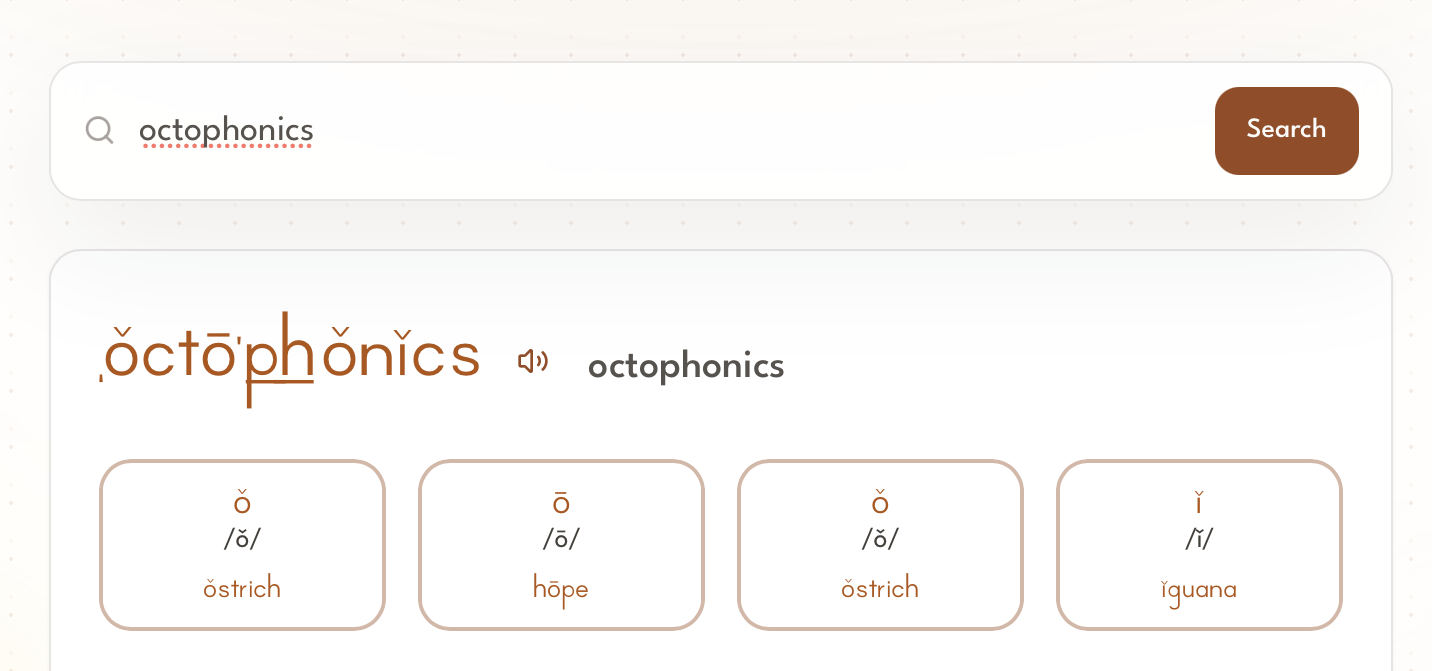
A set of symbols, which we call Octomarks, is added directly to the word’s original spelling.
Without these marks, a letter may represent several different sounds. With them, its pronunciation becomes explicit. Because the marks sit directly on the original spelling, they reveal the word’s sound structure, allowing readers to see at a glance how each part is pronounced.
To put it in one sentence: “Through its carefully designed Octomarks, Octophonics stitches sound and spelling together.” Once students have mastered each Octomark, they can use the system to accurately pronounce any English word marked with it. Try it for yourself.
III. What We Got Right
Before examining what Octophonics does in practice, I want to begin with something essential: a clear instructional focus.
1. Assigning Distinct Responsibilities Within a Complex Educational Task
Learning to read and understand English involves far more than pronunciation. These children needed vocabulary, knowledge, communication, and opportunities to engage with meaningful texts. Those needs remained part of their daily education. We entrusted these broader responsibilities to the American teachers teaching online. The Chinese teachers working with students in person had one specific responsibility: to help the children learn to read words.
Looking back, this arrangement was crucial. The American teachers could concentrate on developing understanding and keeping lessons engaging. The Chinese teachers could focus on one thing: helping students build what we thought of as the mental “muscle” for reading words.
New students joined our schools at different ages. We generally placed them directly into English-medium classes, at most moving them slightly below their expected grade level so that their classmates would still be a reasonable social and cognitive match. Even when they could not yet understand the lessons, we wanted them learning alongside their peers, without holding them to the usual expectations for homework completion or test results during this transition. We temporarily suspended their mathematics and Chinese lessons, devoting substantial time and attention instead to learning the Octophonics system and practicing reading and spelling common, high-frequency words marked with Octomarks. In our classroom experience with this intensive arrangement, typically after about two months, once they had completed the ninth major section of Octophonics, they began to feel more at ease in their regular English-medium classes. The American teachers were often surprised by the change: children who had arrived barely able to participate could, two months later, read their textbook passages successfully.
These results grew out of a focused arrangement, with different teachers carrying clearly defined responsibilities.
The American teachers made lessons lively and engaging, drawing on their own language and cultural backgrounds to help children see the larger picture behind the material. They could enjoy teaching and the exchange of ideas with their students. A teacher’s enjoyment of that process matters greatly in education.
The Octophonics teacher does not give students a word’s pronunciation to repeat. Instead, the teacher guides them to examine its structure, identify the sounds indicated by the Octomarks, and blend those sounds to read the word for themselves. The number of English words a learner may encounter is effectively open-ended, but the elements students practice are finite and organized: vowel and consonant cards, word-family cards, and word-ending cards. Once students have mastered that finite set, they can use it to read any English word marked with the system. During this training, teaching word meanings is outside the teacher’s assigned task. The focus is on one goal: developing students’ ability to read words—not only the words in front of them, but any word presented with Octomarks.
This sounds straightforward, but many things can pull instruction away from that goal. Teachers do not have to devise a response to every difficulty on their own; they need to follow the materials closely. The curriculum anticipates most of the problems they are likely to encounter and explains what to do, what to avoid, what to attend to, and what to let pass. Each lesson provides clear tasks, instructional objectives, teaching directions, and criteria for mastery. Teachers have a concrete sequence to follow. The detail of the system, the consistency of success across learners, and the progress teachers can see in their own students give them the confidence to carry the instruction through. That sustained commitment provides a firm foundation for students to develop the intended capabilities.
2. The Goal Is a Transferable Capability That Students Can Use Again and Again
We do not intend to remain beside students indefinitely, helping them pronounce words. We want them to learn how to do it themselves.
In China, children learn pinyin in first grade. Once they have mastered it, they can use the accompanying pinyin to pronounce any Chinese character. This was what we wanted to achieve for English: give students a system they could use to read words independently. We wanted to go beyond knowing phonics rules or drawing on familiar patterns—for example, knowing that c often represents /s/ before e or i. English pronunciation is complex, and familiar patterns do not always provide a reliable answer. Our aim was to develop something as readily usable as pinyin: a practiced response that no longer requires conscious deliberation, a kind of “muscle memory” that we believed every learner could develop through appropriate training. We saw comprehensive pronunciation marking as the key to moving from learning about rules to practicing a reliable skill. Octophonics gave English a pinyin-like system.
Once the goal shifted from reading the word at hand to developing the ability to read any marked word, the training naturally began to look different from the phonics instruction we had encountered.
The first task was to change what students instinctively noticed when looking at a word. We wanted their attention to shift from recognizing the word as a whole to noticing its Octomarks—and, through those marks, examining its structure. This initial change was crucial because the subsequent training depended on it. Recognizing familiar words as wholes gives children quick success with a small vocabulary, reinforcing a habit they may continue to rely on even as unfamiliar words multiply. Learning to examine a word’s structure requires deliberately designed drills. This temporary change concerns attention during focused structural practice; the eventual goal remains accurate, automatic recognition of words in their conventional spelling.
For many students, recognizing familiar words as wholes had already become second nature. During focused practice, our first task was to interrupt the habit of supplying a familiar whole-word answer without examining the target structure. Daily practice with Octomark cards made the marks increasingly familiar, so that students would naturally notice and attend to them when examining a word. Children—and teachers undergoing training—sometimes told us that words they had previously recognized now seemed unfamiliar. We understood this as a sign that their way of attending to words was changing.
Our training worked in both directions. Some of the phonics programs we tried placed greater emphasis on sounding out written words. Comprehensive pronunciation marking enabled us to build a coordinated routine in both directions: from print to sound, reading a written word; and from sound to print, spelling a spoken word. As with reading, producing the correct spelling was not our only concern. We wanted students to arrive at it through a deliberate, structured process that they could later apply to longer and more difficult words.
Why place so much emphasis on the reverse direction? In our teaching, we found that learning to spell a word made an important contribution to learning to read it. Words students could spell remained readable to them after the Octomarks were removed. This structured, two-way connection is made possible by the way Octophonics stitches the sounds of English directly into its spelling. In other words, by taking the complexities of English pronunciation into account and extending phonics into a system that explicitly marks every sound, we opened up new possibilities for learning and practice that we seek to develop through this comprehensive marking system.
Through this focused training, students quickly learned the procedures and became able to read an expanding range of increasingly long words. Alongside that ability, a new attitude emerged: “I can do this. I know how. I want to try.” They began to move beyond waiting to be taught and showed a strong inclination to sound out English words they encountered in everyday life. A child who can read a long, unfamiliar word naturally attracts surprise and praise. That encouragement helped confidence and interest grow. Small experiences of independence accumulated into a willingness to take charge of learning. Combined with the American teachers’ engaging online lessons and steady progress through the curriculum, the results went far beyond what we had anticipated. A problem that had seemed as difficult as landing on the moon had become something we could solve.
We were astonished. What was it about Octophonics that could bring about such a transformation? We kept returning to that question, trying to understand the power we were seeing at work. Our sense of wonder found its way into the title of the Chinese edition: Octomaster English Force Awakening System. “The awakening of an English force” captured what it felt like to us—as though a power within our students had come to life.
Several years later, we encountered the Science of Reading. It felt like meeting someone far from home who understood what we had been trying to say. Here was a body of research that, at a theoretical level, supported many of the learning principles we had come to recognize through Octophonics. Our practical experience and the research seemed to be moving toward each other. Let us look at where they meet.
IV. Where Octophonics and the Science of Reading Meet
Let us begin with some familiar concepts from the Science of Reading and explore how research and our classroom experience have converged.
1. Phonemic Awareness
Phonemic awareness is the ability to consciously identify and manipulate the individual phonemes in spoken words. A child can do more than understand or pronounce a word as a whole: they can attend to its component sounds and segment, blend, or substitute them.
Octophonics shares this emphasis. A child’s ability to read a word does not necessarily mean they can distinguish the phonemes within it. Learning to attend to those individual sounds, rather than relying on whole-word familiarity, is foundational to the Science of Reading. It is also an essential first step in Octophonics training.
Octomarks make this work possible by explicitly marking the phonemes. Students do not have to work out which sound a spelling represents before they can begin: the marks make those distinctions visible.
Comprehensive marking also gives students a compelling reason to develop phonemic awareness. The entire Octophonics system is built around phonemes, and working with those sounds—separating, combining, and substituting them—is central to its word-reading practice.
2. Phonics and Decoding
With Octomarks, the pronunciation information students need for decoding is already made explicit within the word. Both reading and spelling practice reinforce these sound–spelling connections. To read, students work through the marked word one marked sound unit at a time, following a fixed sequence: start with the vowel, identify the preceding consonant sound or sounds, and then blend. We call this the Three-Step Method, or TSM. For dictation, students work in the other direction: they break the spoken word into syllables, separate each syllable into its consonant and vowel components, and write the corresponding spellings in order.
A major difficulty in conventional phonics comes from a characteristic of English itself: its vowel spellings can represent many different sounds, leaving learners uncertain about which pronunciation to choose. Octomarks explicitly indicate the intended vowel sound. Students can respond to the mark without having to deliberate over competing possibilities. Once the response to a mark is secure, that source of uncertainty is removed; when a mark is unfamiliar, it becomes a clear target for further practice.
Teachers and parents are not simply afraid of a child falling behind. What troubles them is seeing the difficulty without being able to locate its source—or knowing what, specifically, they can do to help. By making the structure of pronunciation visible, Octomarks also help make difficulties visible. Once we can see where a learner is getting stuck, we are much closer to knowing how to help.
3. Automaticity
Automaticity matters enormously. Students need to become fluent in the operations they have learned so that they can move forward. Yet the complexity of English pronunciation can make that difficult to achieve.
An unfamiliar word can set a child’s nerves jangling. Which rule applies here? Which sound should this letter represent? The same letter offers several possibilities, and a familiar rule may not work in this word. Wrong choices become recurring experiences, and each disappointment can make the next attempt more anxious and uncertain. How can a response become automatic while the learner is still struggling to decide what to do? Automaticity means being able to act with little conscious effort, but this task can demand considerable deliberation.
Comprehensive marking changes the task. There are many Octomarks because English pronunciation is complex, but the set is finite. Students can practice responding to those marks until the responses become automatic. We describe this as “muscle memory”: like swimming or riding a bicycle, a well-practiced skill becomes available without having to think through every movement. This is the quality we seek in sound–spelling work—an increasingly effortless response that students can continue to call upon as they learn.
As a skill becomes automatic, one outward sign is speed. We recognized this in our teaching with Octophonics, which is why we emphasize rapid oral reading from the very beginning and include it in every lesson’s mastery check. Reading aloud quickly and accurately is itself a powerful way to develop automaticity.
4. Orthographic Mapping
Another concept in the Science of Reading is orthographic mapping: the process through which a word’s spelling becomes linked in memory with its pronunciation and meaning, allowing the word to be recognized accurately and automatically without being decoded sound by sound each time. The immediacy can feel like looking into a mirror: the moment you look, the reflection is there. [9]
We, too, recognized the need for connections that become readily available in this way. In the preface to our materials, we used the term “synesthesia” to describe the experience we wanted students to develop. We were using it as an image, rather than in its strict scientific sense: a word’s written form seems to call up its sound, while its sound seems to bring its spelling into view. Seeing the word feels almost like hearing it; hearing it feels almost like seeing how it is written.
That description expresses our teaching aspiration. Orthographic mapping offers a research account of how spellings become securely connected with pronunciations in memory. The two descriptions meet in our concern for durable connections that students can call upon with increasing ease.
5. Fluency
At the word level, students need fluency. This is another reason we place such emphasis on spelling. Students need to be able to spell words as well as read them: being able to spell a word helps make reading it more secure and fluent.
With Octomarks, a marked spelling points to a specific pronunciation. In the other direction, a pronunciation may have more than one possible spelling, but the choices are limited. As we like to put it, we have turned a “fill-in-the-blank question” into a “multiple-choice question.” It still takes effort, but much less. In our spelling bee training, we have observed students practice and correctly spell approximately 100 new words within a day. This describes performance during training; longer-term retention needs to be checked through subsequent review and dictation. During this practice, their attention stays on spelling, without the added task of learning definitions. As they read, they attend to the structure of each word and notice exactly which letter or letter combination represents each sound. With repeated exposure, they begin to recognize parallels across words. Those familiar patterns then give them something to draw upon when they work in the opposite direction, from sound to spelling.
We also recognize that being able to read marked words using Octophonics is not enough. We may mark a few key words within a passage, but too many markings can interrupt the flow of reading. More importantly, students should already be able to read most of the words in a passage fluently before they begin. To support this work, we are developing Octospell, an online tool with a different purpose from Octospect, introduced later in this report. Octospect supports teachers in preparing marked words and texts, and its browser extension also supports individual readers. Our vision for Octospell is a social space built around spelling. There are no fixed roles of teacher and student; everyone is a learner. Participants can form groups to practice together or team up for online spelling challenges, earning Inkles, our “ink coins,” as their efforts accumulate.
Developing fluency across a large vocabulary takes more than classroom time. It takes students’ own willingness to practice, supported by the people who share their everyday lives.
6. Schwa
Schwa is often given too little attention in phonics instruction, partly because it is difficult to address through straightforward spelling rules. Yet it accounts for a substantial part of the complexity of English pronunciation. In unstressed syllables, many vowels and vowel combinations lose the pronunciation learners might otherwise expect and are reduced to schwa.
Reading instruction informed by the Science of Reading recognizes schwa as a regular feature of English sound–spelling relationships—one that instruction needs to address explicitly.
Octophonics takes the same view. Alongside a dedicated shoulder mark, ə, which explicitly identifies schwa, we developed a distinctive way of organizing and teaching word endings. We noticed that most English multisyllabic words do not carry their primary stress on the final syllable. Many frequently occurring unstressed endings contain schwa, while certain other endings commonly contain a reduced vowel that we teach as short i. These recurring patterns give us a practical reason to teach such endings as recognizable units. Consider words such as:
ˈar_ti^cle_3 ˈca-pa+eble_3 ˈgar_ment_4
ˈro-dent_4 de+iˈpe^ndence_5 i^nˈte^ll_i+eg~ence_5
Once students can recognize and handle the endings as familiar units, these long words become much more manageable. There is less unfamiliar material to work through, and their apparent complexity begins to fall away.
Across these familiar concepts from the Science of Reading, we recognize principles that we also arrived at through classroom practice. These principles underpin the entire Octophonics training system and have helped produce the remarkable changes we have witnessed in our students. For us, Octophonics brings the science of reading to life in the classroom.
V. Teaching Strategies Made Possible by Comprehensive Pronunciation Marking
Although we have touched on these strategies already, they deserve to be brought together here: what does comprehensive pronunciation marking make possible in Octophonics?
1. Making Sound Visible
What could once only be heard can now be seen.
Octomarks place pronunciation markings directly onto a word’s original spelling. Students still see the English word itself, while the marks clarify how its letters represent sounds in that particular word. Teachers and children now have a shared point of reference. A teacher can point to the part they are discussing, rather than repeatedly saying, “Listen again.” Children, too, can show which sound they heard, which spelling they chose, or exactly where they feel uncertain.
2. Making Difficulties Traceable
One of the most frustrating things about reading difficulties is that the struggle is obvious, but its source often is not. Even reading a familiar word correctly does not always reveal how a child arrived at the answer. If the process behind that success cannot be used again with unfamiliar words, the limitation will eventually become an obstacle.
One of the Science of Reading’s greatest contributions is to clarify the component abilities involved in learning to read. Yet understanding those principles does not automatically tell a teacher how to put them into practice. The processes are subtle and interconnected, and the distance between understanding a theory and knowing what to do with a struggling child can remain considerable.
Octophonics builds these principles into the exercises students complete and the expectations they must meet. Octomarks work together with the Three-Step Method (TSM): identify the vowel sound, identify the preceding consonant sound or sounds, and then blend. Through a carefully arranged sequence, the materials gradually carry this process into increasingly complex structures.
Throughout, the child does the work: reading marked words, adding the marks independently, and spelling from dictation. The accompanying Octocards also let children select and arrange the components themselves before carrying those operations into writing.
The complex task of reading a word becomes a sequence of visible, manageable steps, each of which the child must take. Errors and areas of uncertainty become easier to locate. Teachers can observe the process leading to an answer, while children have something concrete to try when the answer does not come immediately. They can take action instead of waiting for the teacher to supply it.
3. Giving Children Room to Work Independently
A child may pause while working through a word. The teacher already knows the answer; the child still needs time to find it. Our focus is on building ability, and no one else can build that “muscle” for the learner. Octophonics therefore explicitly asks teachers to protect this opportunity. When a child cannot read a word, the teacher uses Octocards to guide and prompt, rather than simply supplying the pronunciation. These familiar tools give the learner a way to work through an unfamiliar word, read it back, and check the result.
When we think of word-reading practice as training a muscle, we make room for each child’s pace. Children need repeated experiences of taking action and completing a task for themselves. Our goals include accuracy and proficiency, along with the confidence to attempt a word independently—to feel that there is something they can do when they encounter difficulty.
A clearly focused teaching responsibility and a clearly defined goal give teachers and children room to adjust the pace. Familiar material can move quickly; connections that are not yet secure can receive the attention they need. Sometimes it is also reasonable to move ahead before everything is fully settled. Instead of worrying vaguely about “weak foundations,” the teacher knows precisely which connection needs strengthening. Further learning may give that connection time and context to develop, and the teacher can return to targeted practice when necessary.
4. Words Are Keys to Reading—and to Knowledge
Children need opportunities to become familiar with words before meeting them formally in their textbooks.
This preparation cannot all be squeezed into the current subject lesson. It needs dedicated practice as well as continued opportunities in everyday life. Classroom time is precious, and teachers’ energy is finite. Expecting teachers to carry the entire responsibility is unrealistic. But who can help beyond the classroom, and how?
Ubiquitous captures it beautifully: words are everywhere. Children see them on menus and labels. They hear them on television and catch them in passing during adults’ conversations. We are all surrounded by words, all the time. Our task is to help children become more sensitive to this language—to notice and make use of what is already there.
If children have encountered a word in phonics practice—heard it, read it, and developed fluency in reading and spelling it—that word has something to connect with when it appears in everyday life. Previously, it might have drifted past unnoticed. Now it catches their attention, and they may also notice something about the situation in which it is used. That encounter may not be enough to establish a clear meaning, but it can leave a trace of familiarity. When they meet the word again, it no longer feels entirely new.
Fluency with these words also gives children confidence to read beyond their schoolwork. Textbooks cover a finite range of material in a predetermined sequence, but children’s interests lead in many directions. Their own reading will bring them into contact with words their textbooks have not yet introduced. If too many are completely unfamiliar, reading can grind to a halt. But if children can readily sound them out, many words in books for younger readers will turn out to be words they already know from spoken language. They can recognize the meaning and keep reading with interest. And, as with any muscle, continued use builds strength.
The work of addressing America’s reading difficulties therefore begins in school and extends far beyond it. Schools need to equip children with word-reading abilities they can use widely; the world around them has a vital role in expanding their vocabulary and knowledge. Museums, zoos, and art galleries can actively participate by publishing their own word collections and adding Octomarks to signs and labels. Neighborhood shops and major retail chains can take up this responsibility, too. Words—especially words encountered in context—offer clues to knowledge and keys to a wider world. With Octomarks, those silent words begin to speak to children. What a beautiful possibility.
VI. Building on the Science of Reading: A New Focus
When practice is developed into theory, we gain a way to explain why it works and how it can be applied more widely. We were delighted to discover how unexpectedly our work converged with the Science of Reading. At the same time, we saw the difficulties of putting that science into practice in the United States. After returning to these questions again and again, we believe we have found the final piece of the broader SoR puzzle: Reading Pivot Theory.
Let us first take a brief look at how the Science of Reading has developed.
Over time, the Science of Reading has brought together many insightful theories and perspectives: Reading Automaticity, the Simple View of Reading, Matthew Effects in Reading, the Self-Teaching Hypothesis, Scarborough’s Reading Rope, Orthographic Mapping, the Lexical Quality Hypothesis, and the Neuronal Recycling Hypothesis. These theories give conceptual form to experiences that classroom teachers recognize, then bring that understanding back to inform teaching. [4, 5, 6, 7, 8, 9, 10, 11]
The complexity is not there for its own sake. Louisa Moats’s report, Teaching Reading Is Rocket Science, captures something we have also felt on the front lines of teaching: teaching children to read can feel like building a spacecraft for a mission to the moon. Reading is a complex undertaking. Being able to read does not, in itself, mean being able to teach someone else to read. Teachers must first master an extensive body of specialized knowledge to get the teaching right. But in their already demanding daily work, can classroom teachers really find the time to master all of this? Even when teachers have been introduced to these theories, how much can they actually put into practice in the classroom? And as we all know, improving one component a little is not enough to get a rocket off the ground. [12]
Around 2018, the Science of Reading began moving into the public spotlight, becoming a major public issue and putting pressure on the education sector to change. That year, Anne Castles, Kathleen Rastle, and Kate Nation published Ending the Reading Wars: Reading Acquisition From Novice to Expert. The problem of reading difficulties, which had long troubled so many people, now had an identifiable target for blame. The pointing finger had a clear direction. The question that had lingered uneasily in people’s minds—“Why are children failing to learn?”—now had an explicit answer: “Schools are not using effective methods to teach them.” [13]
That same year, Emily Hanford’s investigative report Hard Words brought the disconnect between reading research and classroom teaching into public view. When the pandemic moved schooling into homes in 2020, reading difficulties were pulled out of classrooms and into living rooms, out of education circles and into public view. Then, in 2022, the serialized audio documentary Sold a Story was released. Through the experiences of parents and teachers, combined with interviews and investigative reporting, it pursued a question layer by layer: How had a flawed idea about teaching reading become so widely adopted in schools? [14, 15]
In the public mind, educational accountability now had clearer targets. Public outcry intensified, putting pressure back on the institutions and professionals involved—from teachers and schools to curriculum authors and publishers. The established approaches could no longer avoid the challenge posed by SoR. Some revised their curricula; others defended their methods; publishers began adjusting their products and how they presented them. Whether these responses would lead to meaningful changes in classroom teaching remained an open question.
Yet both the data and the realities of classroom teaching show that the problem remains unresolved. Was the finger pointing in the wrong direction? Yes—and no.
Schools certainly need to keep updating their understanding of reading instruction. Teachers cannot rely on classroom experience alone or focus too narrowly on children’s immediate comprehension. Every teacher needs to equip children for the reading demands of the next stage. The report Preventing Reading Difficulties in Young Children emphasized early prevention and sustained instruction, providing a basis for attending to later reading development. [16]
But in the realities of teaching, this expectation is unrealistic. Reading is a complex undertaking, and no single teacher can attend to every part of it. When teachers are expected to keep every ball in the air, crucial ones—especially the one that matters for children’s future reading—end up on the floor.
After closely examining the current state of reading education in the United States, we returned to our own successful experience and looked more carefully beneath it. What underlying theoretical principle explains what we did right, and makes it possible to apply that success again and again?
We identified a focus that, we believe, has not received sufficient attention: how support for learning expands, and how instruction can prepare for that expansion in advance. We see it as the missing piece in bringing SoR into classroom practice.
That new focus is the subject of our next discussion: Reading Pivot Theory.
Part Two: Reading Pivot Theory
I. Establishing Sound–Spelling Connections Early to Support Continued Learning
Understanding written language depends in part on knowing the words it contains. But what does it mean to know a word?
For reading and spelling, word knowledge involves three interconnected elements: phonology (P)—how the word sounds; semantics (S)—what it means; and orthography (O)—how it is spelled. Reading instruction aims to make the connections among these elements secure and readily accessible: seeing a spelling brings its pronunciation and meaning to mind; hearing a word allows the learner to retrieve its meaning and spelling; and expressing a meaning involves retrieving an appropriate spoken or written word. Together, these connections form a P–O–S triangle.
How does a child who cannot yet read begin to build this triangle?
The human brain did not evolve an innate system specifically for reading. Writing is a relatively recent cultural invention. Learning to read requires us to recruit and adapt existing visual and language-processing systems—the process described by the Neuronal Recycling Hypothesis. [11]
For children who already understand spoken English, their existing language experience provides an important resource. A child may hear book and know what it means, without recognizing the written word b-o-o-k. Instruction can begin here: the teacher helps the child identify the sounds within a familiar spoken word and learn how letters and letter combinations represent those sounds. The existing P–S connection thus supports the learning of O.
In this example, an established connection between two elements supports the addition of the third. This is the origin of the term “reading pivot.”
A familiar spoken word supports spelling
Established P–S → add O
A familiar form supports learning meaning
Established P–O → add S
In this theory, a reading pivot is an established, accessible connection between sound and meaning (P–S), or between sound and spelling (P–O), that supports learning a word. The learner uses this existing connection to bring in the third element, gradually building and strengthening the P–O–S triangle. These two pivots represent different starting points: a familiar spoken word can support learning its written form, while an established sound–spelling connection can support learning its meaning.
A shift in the reading pivot occurs as the vocabulary demanded by learning through print extends beyond the learner’s existing spoken vocabulary. The support for learning must expand accordingly, with the primary pivot shifting from the P–S connections of early reading toward P–O connections. Students cannot always rely primarily on existing P–S connections. They also need the ability to actively establish and consistently draw on P–O connections, preparing them to learn words that are not yet familiar in speech.
This shift does not mean that existing P–S connections cease to be useful. It means that students have a way to keep learning beyond the words they already know from spoken language.
II. When Familiar Spoken Vocabulary Is No Longer Enough
Before entering school, children who speak English as their first language acquire vocabulary through conversation and everyday experience. Reading Pivot Theory calls these established sound–meaning connections a P–S word bank. As children learn the written forms of familiar spoken words, they gradually build a P–O–S word bank, linking pronunciation, meaning, and spelling.
Early reading instruction can draw extensively on this spoken vocabulary. However, children differ considerably in which words they know and how well they know them.
After school begins, the P–S word bank continues to grow, but the vocabulary demanded by the curriculum may expand faster. Science, history, literature, and other subjects introduce words rarely encountered in everyday conversation. Learning a written word is then no longer simply a matter of adding a spelling to a familiar spoken word: its pronunciation and meaning may also be new.
Reading Pivot Theory seeks to explain a difficulty seen in American reading education: some children manage early reading but encounter increasing difficulties in the middle and upper elementary grades. This problem is often discussed in connection with fourth grade; as academic demands increase in middle school, the difficulties may become more pronounced.
The theory proposes one possible explanation: a mismatch develops between the expanding written vocabulary of the curriculum and the P–S resources students can draw on, while the P–O connections—and the ability to establish them—that could support further learning remain insufficiently developed. This does not mean that all struggling readers have the same difficulties or encounter them at the same age. It identifies a learning risk worth addressing in advance.
The Chinese classrooms in which Octophonics developed faced a different starting point. Beginning English learners already possessed vocabulary and knowledge in Chinese, but their English P–S resources were very limited. The obstacle to reading stood directly in their path from the outset. From the beginning, they needed another source of support: P–O connections. In our approach, this support is established from the start, rather than introduced later when an initial reliance on familiar spoken vocabulary becomes insufficient.
This experience raises a question for reading instruction in the United States: while familiar spoken vocabulary is still helping children learn successfully, can we already begin preparing them to move beyond what they know?
III. Building a P–O Word Bank That Can Keep Expanding
Consider a student encountering photosynthesis for the first time. The word is not part of his familiar spoken vocabulary, so he cannot directly connect its written form to a spoken word he already knows. Its pronunciation, spelling, and scientific meaning all need to be learned.
In the Octophonics system, clear pronunciation markings and guided practice allow the student to learn how to read and spell the word—and how its spelling corresponds to its sounds—before understanding the scientific concept. Perhaps two years later, he formally encounters the topic in his curriculum. The word appears repeatedly in the text, and the teacher uses it repeatedly in explanations. Because its pronunciation and spelling are already familiar, these encounters can reinforce the existing P–O connection while making it easier to learn the meaning and attend to finer details than if the word were entirely unfamiliar.
This captures something we felt while teaching Octophonics in China: it seemed as though children’s intelligence in English had grown—as though their underlying capacity to learn through English had awakened.
Let us summarize what has happened. Through word-reading and spelling practice, students establish many P–O connections, collectively forming what we call a P–O word bank. This bank can include words whose meanings are unknown, partially understood, or still developing. When students later encounter explanations or helpful contexts, they already have recognizable spoken and written forms to which they can connect newly acquired meaning, building a more secure P–O–S triangle.
Building this P–O word bank addresses the word-level dimension of fluency, the third of the five pillars commonly associated with the Science of Reading. Octophonics extends its training beyond fluent word reading in one direction to include spelling in the other. Our teaching experience has led us to emphasize this reverse pathway: students need to read fluently and spell confidently. Words they can spell are words they tend to remember more securely.
Traditional vocabulary lessons ask students to establish P–O–S connections together. When we temporarily set aside the most complex element—S—and concentrate on P–O connections, we can move much more quickly through the sound–spelling work.
This is the approach we have used in spelling bee training. Faced with long, difficult words rarely encountered in ordinary textbooks, we did not require students to study meanings and example sentences as part of the initial training. We concentrated on repeated oral reading and spelling practice. In our experience, the results were striking: students with different starting levels could move forward when they were willing to participate in the training. We also noticed something else. Although learning meanings and example sentences was not a shared requirement, children who wanted to go further began reading them on their own—and were able to understand them.
Now consider everyday classroom learning. Reading materials become progressively more demanding, and unfamiliar words accumulate rapidly across subjects. Students’ P–O word banks therefore need to keep expanding, without taking excessive time and energy away from their current studies. After all, much of this work is preparation for what comes next. It requires a method that is efficient, manageable, and rewarding, so students are willing to learn and teachers can guide them without constant pressure.
Octophonics is designed to meet these needs. It develops a repeatable, expandable ability: instead of confronting each new word as something entirely different, students begin to recognize familiar structures within it.
Octomarks preserve a word’s conventional spelling while indicating letter groupings and providing clear pronunciation information. TSM trains students to approach words as combinations of sound units, quickly locating vowels and the consonants that precede them. This builds a consistent way of handling sound–spelling structures. The three core vocabulary practices—reading marked words, marking words, and writing words from dictation and then marking them—provide repeated practice in both directions: from print to sound and from sound to print.
With Octophonics providing a strong tool for the second pillar, phonics, the online tool Octospell gives learners a place to collect vocabulary and practice it efficiently. They can use their phonics knowledge to develop the word-level fluency associated with the third pillar, adding increasingly secure connections to their P–O word banks. These connections, in turn, prepare the ground for the fourth pillar, vocabulary, as meanings are learned and the words become part of a fuller P–O–S word bank.
IV. Preparing Words Before the Classroom Needs Them
One of the questions we encounter most often when teaching Octophonics is: “What about meaning? What is the point of being able to read and spell a word if you do not know what it means?” For teachers, students, and parents, this is an entirely natural question. It is also often the greatest obstacle to their willingness to begin learning Octophonics.
The question extends beyond our own system. The five pillars of reading distinguish fluency from vocabulary knowledge. Although they are not a fixed sequence of stages, this distinction leaves room for an important teaching opportunity: a student can develop fluency in reading a word before fully understanding its meaning. When reading and spelling without prior knowledge of meaning are dismissed as pointless, that opportunity is lost. [3]
By defining the “reading pivot” and describing the shift that we propose becomes necessary as reading extends beyond familiar spoken vocabulary, we aim to give a theoretical explanation for this teaching opportunity.
Reading Pivot Theory also proposes a way to support the fifth pillar, reading comprehension. Our recommendation is explicit: prepare words before they are needed in the classroom. Before a word appears in formal subject instruction, give students time to learn how to read and spell it. Sound–spelling preparation should keep pace with academic vocabulary demands—and move ahead of them.
Let us return to photosynthesis. Learning to read and spell this word can be a focused training task before the formal teaching of photosynthesis as a scientific concept. Establishing its P–O connection in advance can offer two benefits.
1. Supporting attention and understanding in the classroom
A familiar word can catch a student’s attention. Having practiced photosynthesis, a student may hear the teacher say it and immediately think, “I know that word!” That recognition can draw attention to the explanation that follows.
Familiarity may also support understanding in another way. Familiar sound patterns are generally easier to retain and reproduce than unfamiliar ones. To illustrate, a sequence of syllables in a language you know well is usually easier to repeat than a comparable sequence in a language you do not know. For an English speaker unfamiliar with Arabic, the difference can be readily apparent.
Understanding does not take place in the isolated instant when each word is heard. Learners need working memory to hold earlier information available and connect it with what follows, gradually forming an understanding. Familiarity with a word’s sound and spelling can reduce the effort of identifying an unfamiliar spoken form, leaving more cognitive resources available to integrate information across the explanation.
This reasoning is consistent with the principle underlying David LaBerge and S. Jay Samuels’s theory of reading automaticity: as lower-level processing becomes less demanding of attention, more resources become available for comprehension. We propose that preparing sound–spelling connections in advance may offer a related benefit during classroom listening. [4]
2. Allowing learning to reach beyond the school walls
A second reason to prepare words well in advance is to give everyday life time to contribute to learning.
Suppose a student has already learned to read and spell photosynthesis through focused practice before encountering it in class. Hearing this substantial word in everyday life may then prompt recognition and curiosity. She may begin to notice the context: people are talking about plants, sunlight, or growth. Through these encounters, the word can gradually acquire some initial meaning.
By the time the teacher formally explains the concept, she may have several pieces of information to recall and connect. The lesson gives her an opportunity to organize them. Where something does not fit, or seems to contradict what she has previously heard, she has a reason to ask a question. Familiarity with the word can thus become a starting point for active participation and productive interaction with the teacher.
Reading has always involved more than decoding. Yet we can see a possible route by which progress from decoding to fluency supports the development of vocabulary and helps prevent reading difficulties.
The approach we propose does not depend on a specially designed reading curriculum that attempts to cover every possible topic. It expands students’ P–O word banks so that more words can become recognizable in everyday encounters, inviting attention to their meanings and allowing the wider world to contribute to learning.
Part Three: The Complete Octophonics System
I. A Structured Course and the Materials That Support It
Reading Pivot Theory emphasizes preparing students for continued learning by establishing sound–spelling connections early. Octophonics puts this idea into practice through a structured course, a shared marking system, student exercises, teacher guidance, and tools that extend learning beyond printed textbooks. Together, these components help students develop an ability they can continue to use as new words enter their lives.
The English edition is designed as a supplementary program. Its four student books cover four semesters, typically beginning in first or second grade. This provides a planned sequence rather than a fixed age requirement. Older students can also benefit from the foundational instruction, with pacing and presentation suited to their needs.
The course begins with manageable sound–spelling units and establishes a consistent way of working with them. It then progresses through vowel and consonant combinations, word families, longer structures, stress, and word endings, eventually applying the same methods to academic vocabulary.
| Student book | Course content |
|---|---|
| Book 1 | Units 1–3 |
| Book 2 | Units 4–8 |
| Book 3 | Unit 9 and the first part of Unit 10 |
| Book 4 | The second part of Unit 10 and Unit 11, including academic vocabulary across 16 themes |
As the words become more complex, the basic learning routines remain familiar. Students can devote more attention to the structure of each word because they already know how to approach the task.
The course materials work together to support this process.
| Component | Purpose |
|---|---|
| Four student books | Provide four semesters of instruction and guided practice |
| Teacher’s Edition | Connect student content with goals, procedures, and mastery expectations |
| Teacher display cards | Support whole-class demonstrations of sounds, spellings, and marks |
| Student Octocards | Let learners select, arrange, blend, and check sound–spelling elements |
| Posters | Keep introduced structures available as shared references |
The Teacher’s Edition connects these materials with the teaching behind them. It helps teachers understand what students are practicing, what their responses reveal, and how to guide them toward greater accuracy and fluency. [17]
II. Octomarks: Making Sound Visible, Discussable, and Usable
English spelling does not always make pronunciation readily apparent. The same letter or letter combination can represent different sounds, and unfamiliar words can leave learners uncertain about how their parts fit together.
Octomarks place pronunciation information directly on a word’s conventional spelling. Students continue to see the original letters and their order while also seeing how those letters represent sounds in that particular word.
The purpose is to provide a tool that can accompany learners beyond introductory word lists. Everyday words, long words, less predictable spellings, and specialized terms can all become material for sound–spelling learning.
For an unfamiliar word without marks, students may still need a dictionary, a teacher, or another reliable pronunciation source. Once the pronunciation is established, Octomarks provide a visible reference that students can use in reading, marking, and spelling practice.
The marks make the relationship available for study. Teachers can point to a specific element; students can use their own markings to show how they understand the correspondence. Sound becomes something they can observe, discuss, and work with together. Repeated practice helps students make that relationship their own.
III. TSM and Octocards: Giving Students a Way to Work Through Words
Seeing pronunciation information is only part of the process. Students also need to know how to work with it.
TSM provides a repeatable procedure that begins with the vowel, identifies the consonant or consonants preceding it, and blends them into a sound unit. As words grow longer, students learn to work through these units systematically.
This directs their attention to structures within a word that they might otherwise overlook. Early practice also uses isolated syllables and smaller combinations, so students must examine the structure and blend the sounds rather than supply a familiar whole-word answer.
TJ, a speech-language pathologist and mother, described this in her experience with her son Ezekiel. Although he was already reading beyond expectations for his age, she noticed that he often attended to the beginnings and endings of words while overlooking the vowels in the middle. [18]
At first, TSM’s instruction to begin with the vowel seemed counterintuitive to her. In practice, however, she found that it brought Ezekiel’s attention to precisely the part he tended to miss. She later reported improvements in his attention to medial sounds, phoneme segmentation, and handling of longer words. He also began noticing spelling patterns and using Octomarks in his own writing.
Student Octocards make this work visible and tangible. The sets include consonant and vowel cards, word-family cards, and word-ending cards. Students select and arrange the elements, read what they have constructed, and check their choices.
The course also asks students to identify different spellings that can represent the same sound. Sound analysis and memory for a particular word’s spelling therefore work together from the beginning. Teachers can then see more than whether an answer is correct. They can observe which vowel a child selected, how the consonants were positioned, and where two forms became confused.
The same materials can also support different kinds of participation. For her young child, TJ placed large cards on the floor and let him move between them. The activity suited his age while still asking him to make specific sound–spelling judgments.
IV. Three Core Practices: Reading, Marking, and Spelling
Octophonics brings sound–spelling learning together through three core practices:
Reading marked words aloud.
Adding marks to words.
Writing words from dictation and then marking them.
These activities require students to work in both directions: from spelling to sound and from sound to spelling.
Reading marked words develops the ability to interpret the spelling and produce the pronunciation. Marking words asks students to identify how the sounds correspond to the written structure. Dictation requires them to retrieve and write the spelling, then examine it again through marking.
English sounds can have more than one possible spelling, so accurate spelling also depends on learning the particular form used in each word. The two directions reinforce that learning.
Reading a word correctly once is an initial achievement. The aim of continued practice is for students to read it accurately and fluently and spell it with growing confidence. Checks of mastery therefore need to include fluent oral reading as well as written work.
Mary, an experienced teacher, noticed gaps beneath her son Luke’s generally strong reading performance. Sometimes he had to recall a familiar word before he could work out the sound associated with a letter. Working through the course from the beginning helped her identify and address relationships that might otherwise have been assumed secure. [18]
She also reported that Luke’s schoolteacher noticed changes in his spelling and asked what they had been doing at home.
Luke offered another reminder about the learning process. When his mother moved too quickly, he asked her to give him a little more time. During that pause, he could be identifying the spelling, working out the sounds, blending the word, or checking his response. Allowing time for those steps gives students a chance to complete the work themselves.
V. The Same Principles, Different Starting Points
The Chinese and English editions share the goal of developing sound–spelling ability, but they respond to different learning environments.
The Chinese edition combines student and teacher content in one volume, accompanied by a vocabulary workbook. It was developed for learners with limited English oral vocabulary who nevertheless needed to participate in an English-medium education. Its service-word component—common words selected to support early classroom participation and reading—addresses immediate needs in that setting.
The English edition serves as a supplementary course in schools where the main reading program is expected to cover common service words and broader reading instruction. It therefore does not include service words as a separate component.
These differences reflect the responsibilities of each edition. Both provide systematic practice in establishing and using sound–spelling connections.
As the course advances into academic vocabulary, students continue to need practice in both reading and spelling. Even where a separate printed workbook is not provided, dictation remains necessary. Dictation remains part of the teaching, and teachers need to provide the corresponding written practice.
At this stage, students will sometimes learn to read and spell a word whose meaning is still unfamiliar.
Mary described this with Luke. He would sometimes read a word aloud and then ask whether it was a real word. They could mark it for later attention, look it up afterward, or explore it through a sentence. [18]
This is a concrete example of the relationship described by Reading Pivot Theory. A student can establish one part of word knowledge and then build on it through subsequent explanation and experience. The familiar pronunciation and spelling give that later learning something to connect to.
VI. Octospect: From Teaching Preparation to Online Reading
Printed textbooks can organize a learning sequence, but they cannot contain every word students will eventually encounter. A teacher preparing a new science unit, a child beginning an interesting book, or someone reading an article online may all meet vocabulary beyond the course materials. Octospect allows pronunciation support to follow these needs into new learning materials.
For teachers, Octospect is a tool for preparing instruction. It helps them work with vocabulary and texts, adding Octomarks so that students can continue applying the sound–spelling methods they have learned.
A science teacher, for example, can gather unfamiliar terms from an upcoming unit and arrange reading and spelling practice in advance. When the concepts are formally introduced, students already have familiar written forms and pronunciations to draw on. Tutors can prepare difficult words from students’ reading, while parents can help children pronounce unfamiliar names and places in books. Octospect reduces the work involved in preparing marked materials, making this support easier to provide in everyday teaching.
Through its browser extension, Octospect also becomes a reading tool for individual learners. Users can add pronunciation marks to words in online articles according to their own needs and collect words for further study in a vocabulary collection called a Wordlet.
Different readers may need help with different words in the same article. The browser extension lets each person choose support based on what they are reading. A difficult word can be marked to help them continue; a word they want to learn can be saved for later reading, marking, and spelling practice.
This also broadens the sources of learning material. Vocabulary does not always have to be selected by a teacher or introduced in textbook order. A report about space, a passage about animals, or an article connected to a personal interest can all become starting points for building a P–O word bank.
Reading helps learners discover which words they need. Marks help them work through an immediate difficulty. Wordlets turn that encounter into an opportunity for continued practice.
From teacher preparation to learners’ own word collections, Octospect brings the same sound–spelling tools beyond printed textbooks and into online reading. It also supplies material for the ongoing practice and shared learning that follow.

Octospect
Scan to access the tool
VII. Octospell: Helping the P–O Word Bank Keep Growing
Octospect brings pronunciation support into teaching and everyday reading. Octospell is designed to provide a space for continued practice and shared learning—a social tool centered on spelling.
The intention reflects a principle that runs throughout Octophonics: learning needs opportunities to move beyond the classroom and into everyday life, where learners can begin choosing and pursuing it for themselves.
After completing the Octophonics course, students will continue to encounter new words. They will also need to strengthen connections they have only begun to establish. Octospell extends this practice online through tasks involving listening, identifying sound–spelling structures, and spelling independently. Learners can expand their P–O word banks while returning to words that still need practice.
Within this design, everyone participates as a learner. Teachers, students, and other users can create their own learning groups, share vocabulary collections, or form teams for word challenges and earn Inkles.
The words can come from an upcoming unit, a book a group is reading together, or an individual interest. Learners have a reason to practice because the vocabulary belongs to something they want to understand or take part in.
This design also builds on our experience with spelling bees. Learning a set of words together and preparing for a shared challenge can turn individual practice into something people actively pursue with others.
We want these social activities to remain centered on vocabulary learning. Participants can share collections, prepare together, and see one another’s progress. The lasting satisfaction comes from being able to read more words, spell more words independently, and approach unfamiliar words with greater confidence.
The course helps learners get started. Their own needs, the participation of others, and continued practice help that ability keep growing in everyday life.

Octospell
Scan to access the tool
https://spellingocto.octophonics.net
VIII. ReadBible: Opportunities for Churches to Participate
ReadBible.site brings Octophonics marking into Bible reading. Unfamiliar names, places, and other words can cause readers to hesitate even when the text matters deeply to them. Marked text provides a shared reference for working through those words.
Churches already offer settings in which reading has a meaningful place: Bible study groups, family reading, and gatherings across age groups. These provide both reasons to practice and people willing to help.
Trained volunteers can support sound–spelling practice, while families and study groups explore the meaning of the text. Pronunciation support can help readers approach the words; unfamiliar language and theological concepts still need explanation and discussion.
Church communities can contribute continuity, personal relationships, and a setting where people have a reason to keep reading. Other communities can create similar opportunities around their own books, interests, and projects.
In each case, an ability that can be taught connects with a purpose people already care about.

ReadBible
Scan to access the tool
IX. A System That Remains Useful After the Course Ends
The four-semester course provides an organized period in which to learn the system. Its intended value extends beyond the final book.
Students will keep encountering new words. Teachers will keep introducing new subject matter. Books, online articles, and everyday experiences will continue to bring unfamiliar language into view. The materials and tools should allow a familiar method to accompany learners into these new situations.
The textbooks establish a sequence. Octomarks make sound–spelling relationships visible. TSM gives students a way to work through them. Repeated reading, marking, and spelling develop fluency. Octospect brings new words within reach, while Octospell and shared reading activities provide opportunities to keep learning.
What matters over time is whether this ability continues to serve students as texts become harder and learning demands increase.
With this theory and practice in view, we return to America’s reading crisis: Where has reform in the name of the Science of Reading strayed from its original purpose? And what path forward might the experience of Octophonics offer?
Part Four: America’s Reading Crisis and the Octophonics Response
We return to the question raised in the introduction: Why does America’s reading crisis remain unresolved even after reading science has received such widespread attention?
Educational reform takes time, and the pandemic and absenteeism also affect learning. Yet as educators working in classrooms, we still need to ask: What remains unresolved in the teaching arrangements we can change? If we continue along the current path, will the changes we hope for actually occur?
We believe an urgent concern deserves attention: “Reform in the name of the Science of Reading is losing its direction.”
We offer this criticism precisely because we recognize the important insights of reading science and the difference they could make in classrooms. Unless we identify how to translate those insights into workable instruction, reform may gradually lose its original focus as it expands its demands and revises its explanations.
I. When “Aligned with SoR” Begins to Replace “Solving the Problem”
When alignment with SoR becomes an important condition for curriculum adoption and instructional approval, schools, publishers, and curriculum designers face a shared pressure: to demonstrate that they stand on the right side.
Under this pressure, reform can go wrong in two ways.
One is to force instruction into the theoretical framework, regardless of the fit. In an effort to address every element of the theory, programs keep adding content, procedures, and teacher responsibilities. The plans become increasingly comprehensive on paper, while classrooms may lack the time and conditions needed to carry them out.
The other is to apply a patch. The underlying instructional approach remains largely unchanged, but a few phonics exercises and some scientific terminology allow it to reappear as SoR-aligned.
For education officials who lack expertise in reading instruction and face pressure to demonstrate accountability, “SoR-aligned” may also become the easiest basis on which to defend a decision. Requiring schools to purchase approved materials and complete prescribed training is easier to implement and document than judging whether an instructional approach can work consistently in actual classrooms. If challenged, they can at least respond: “We have followed the science.”
Publishers demonstrate that their products meet requirements. Schools demonstrate that purchases and training are complete. Teachers demonstrate that they have followed the curriculum. Each level can provide an account of what it has done. Those accounts, taken together, do not establish that children have learned to read.
Alignment with science should help us improve instruction. When it becomes a status to display, reform may become increasingly skilled at proving itself right and increasingly unable to recognize where it is falling short.
We need to bring our judgment back to the student: What ability has this child actually acquired? Can it be used independently? As the curriculum advances, does it continue to support learning?
II. Does “Too Much Focus on Phonics” Fully Explain the Problem?
When students’ reading comprehension remains weak, a common explanation is that SoR has been reduced to phonics in practice: schools have focused too heavily on decoding while neglecting vocabulary, background knowledge, and language comprehension.
This concern has merit. But if the discussion ends there, we may again bypass an unresolved question:
“Does receiving phonics instruction necessarily mean that a student has acquired the sound–spelling abilities needed for continued learning?”
There is still a distance between learning some letter–sound correspondences and reading introductory materials, on the one hand, and handling the long words, difficult spellings, and academic vocabulary of later coursework, on the other. Reading a word correctly once with prompting is also a different achievement from reading it fluently and spelling it independently.
If these abilities are not sufficiently developed, students may face several difficulties at once in an academic text: unfamiliar pronunciation, unfamiliar spelling, and unfamiliar concepts. Describing the problem broadly as “a lack of background knowledge” does not identify which part could have been prepared in advance, much less provide that preparation.
There are also understandable classroom reasons why phonics has become the most visible part of SoR reform. Compared with the breadth and ongoing development of knowledge and comprehension, sound–spelling instruction offers more readily defined practice tasks, sequences, and observable outcomes. It gives teachers a concrete place to begin.
We should make good use of that starting point while asking whether it has fulfilled its purpose. If the focus of reform shifts toward additional content before students have developed secure sound–spelling abilities, the original difficulty may remain, obscured by new instructional tasks.
Octophonics asks that sound–spelling ability extend beyond introductory word lists, enabling students to establish secure P–O connections for increasingly complex vocabulary. After the course ends, students should still be able to use the same tools and methods to expand their word banks.
Our concern, therefore, is not simply how much time schools devote to phonics. It is also what that time leaves behind: “A course that has been completed, or an ability that can continue to be used?”
III. Why Can More Comprehensive Theory Leave Classrooms Less Certain About What to Do?
Reading requires vocabulary, knowledge, an understanding of syntax, inference, and the ability to grasp relationships within a text. Recognizing the importance of these factors is a contribution of reading research.
The difficulty is that explaining the conditions reading depends on does not, by itself, explain how teachers can establish those conditions for different students within limited classroom time.
Background knowledge provides an example. Incorporating history, science, and literature into a reading curriculum can provide shared learning material. But an actual learning process still stands between “the curriculum includes this knowledge” and “every student has acquired knowledge they can draw upon.”
Did students understand what they heard? Can they remember it? Can they connect it to prior experience? Will they encounter and use it again? The same explanation may extend one child’s existing knowledge while confronting another with a stream of unfamiliar words and concepts.
Calling the materials a “knowledge-building curriculum” does not automatically resolve these questions.
We need to be cautious about the assumption that, because background knowledge affects comprehension, continually adding knowledge content to a curriculum will produce corresponding gains in every student’s understanding. Additional content may also increase the difficulties students must manage simultaneously and the support teachers must provide.
When students cannot keep up, teachers are asked to offer more explanation, teach additional vocabulary, provide more scaffolding, and differentiate instruction. Each requirement may be reasonable on its own. Together, they may exceed what a classroom can sustain.
“Every element of the theory may matter, but that does not mean a single teacher can adequately teach them all within the same period of instruction.”
This is the concern behind our criticism of some instructional arrangements presented in the name of SoR: Have they translated the complexity of reading directly into complexity that teachers must manage all at once? When results fall short, do they respond by adding further demands rather than reconsidering how tasks should be divided and sequenced?
If a program requires teachers to keep contributing extra time, finding supplementary materials, and making improvised adjustments just to keep it running, those implementation difficulties should themselves prompt scrutiny of the program. Whenever a gap appears between theory and classroom reality, the entire responsibility for closing it cannot simply be handed to teachers.
IV. How Could SoR Lose Its Original Power to Change Instruction?
An emphasis on comprehension and knowledge does not, in itself, constitute a return to Balanced Literacy. The real concern is the reappearance of a classroom pattern: content keeps moving forward while systematic sound–spelling practice once again loses sufficient time, clear responsibility, and an expectation of actual mastery.
The story must be finished, the discussion developed, and the unit completed. Teachers pronounce difficult words, explain their meanings, and help students complete the immediate task. The classroom can be engaging and meaningful, while insecure foundational connections remain unaddressed as lessons proceed.
If this continues, we fear that reform will retain the SoR name while gradually returning to the situation it originally sought to change: students participate in many reading activities without sufficiently developing the ability to handle written words independently. This is the risk we see of returning to familiar instructional patterns under a new name.
If reform retains scientific terminology while gradually losing instructional direction and clear responsibility for implementation, then the “unraveling of SoR reform” that concerns us has begun. Curricula become increasingly comprehensive, yet it becomes less clear what abilities every student must acquire, who is responsible, and how their acquisition will be confirmed. Reform may appear to be advancing while gradually losing its power to change classrooms.
When widely differing instructional arrangements can all claim alignment with SoR, the label itself becomes less useful in helping schools make decisions. We need to specify which abilities must be established, which practices must continue, and how to ensure that students do not carry unresolved difficulties with them as the curriculum advances.
Reading Pivot Theory seeks to identify one such responsibility that can be sustained over time: helping students develop an expandable capacity to establish P–O connections and actively preparing the sound–spelling relationships required for subsequent learning. In this way, students retain support for learning beyond the limits of their existing oral vocabulary.
V. The Octophonics Response: Prepare What Can Be Prepared in Advance
Classroom knowledge and concepts continually change, and students bring different experiences to them. We cannot teach in advance all the background knowledge they will need throughout their lives. We can, however, help them develop a method for working with new words and become familiar with some of the vocabulary they will soon encounter.
This is where Octophonics concentrates its effort.
For a word such as photosynthesis, science instruction still needs to develop the concept. But students do not have to encounter its pronunciation and spelling for the first time as that explanation begins. This part of learning can take place earlier and become fluent through focused practice.
Such an arrangement separates some of the learning tasks that would otherwise compete for attention at the same moment. When subject teachers explain a concept, they can draw on pronunciations and written forms already familiar to students. Sound–spelling instruction, in turn, has an opportunity to complete its own work without having to provide full conceptual instruction during every practice activity.
To make this possible, the tools must keep pace with actual vocabulary needs. Beyond familiar everyday words, students need dependable ways to approach long words, less predictable spellings, and specialized vocabulary. Octomarks provide pronunciation information on conventional spelling, TSM supplies a consistent procedure, and repeated reading, marking, and dictation help students turn this information into connections they can call upon themselves.
We place particular emphasis on practice in both directions. In reading, students move from spelling to sound. In dictation, they retrieve a word’s specific spelling from its pronunciation, then examine its structure through marking. Accurate, fluent reading and independent, accurate spelling together define the performance we want students to develop.
The value of this preparation should also extend beyond a single set of practiced words. As students become more familiar with the method, they can continue establishing connections for the next set. New subjects, books, and interests can all bring new vocabulary without requiring a new procedure each time.
“Preparing a set of words provides immediate help; teaching students how to keep preparing develops an ability for the future.”
VI. Give Someone Clear Responsibility for This Ability
If sound–spelling ability is this important, it needs a place in school that reflects its importance.
My proposal is: “Establish dedicated instruction, with a specially trained teacher responsible for its continuity.”
Subject teachers need to guide students’ understanding, develop their thinking, and advance the curriculum. Sound–spelling instruction requires attention to each student’s mastery, identification of insecure connections, sufficient practice, and the gradual application of the same methods to more complex words. These responsibilities can work together, but each requires focused attention.
A clear division of responsibility also helps address differences among students. Children in the same grade may have very different sound–spelling foundations. We cannot assume they have mastered the same content simply because they are the same age. Nor can we assume that older students no longer need this instruction because the early-grade course has ended.
Students who have not yet mastered these abilities need continued instruction until they do. Mastery should correspond to observable performance: accurate and fluent reading, independent spelling, and the ability to apply learned methods to new words. It cannot be measured simply by the number of workbook pages completed.
The work students do in class also needs to be visible to teachers. Which card they select, which structure they mark, and which element they omit in dictation can all guide the next instructional step. Observing these specific responses provides a clearer basis for help than a general judgment that a child is “a good reader” or “has weak foundations.”
Students also need time to carry out the operations themselves. If teachers supply the answer whenever hesitation occurs, they may keep the lesson moving while reducing opportunities for independent processing. Appropriate prompts, waiting time, and checking are all part of helping students acquire the ability themselves.
When students cannot yet perform a task, they need adjusted practice, additional support, and continued follow-up. The purpose of clear mastery expectations is to ensure that difficulties are addressed and that students gradually acquire abilities they can rely on.
A dedicated teacher can also coordinate with subject teachers to anticipate upcoming vocabulary. Sound–spelling instruction can then follow a stable learning sequence while responding to actual curriculum needs. Its responsibility can extend from the beginning stages into the upper grades, addressing abilities that have not yet been established, are not yet fluent, or need to be applied to more complex vocabulary.
VII. Bring Learning into Everyday Life and Give Students Greater Initiative
School time is limited, so addressing reading difficulties also requires opportunities for learning beyond the classroom.
Our vision is that, once students have mastered sound–spelling tools, they can continue using them in material they genuinely want to read. A book, an online article, a museum display, or even an unfamiliar word on a menu can become a learning opportunity. Appropriate pronunciation support in these settings could bring sound–spelling practice into everyday life.
The Octospect browser extension allows readers to add pronunciation marks to words in online articles according to their own needs and collect words they want to master in a Wordlet. Octospell provides a space for continued practice and shared learning. Families, churches, and other communities can also organize support around material they read together.
In this process, the sources of vocabulary expand. Teachers can select words in advance, and students can collect their own. School subjects can create a need to learn, and personal interests can do the same.
The student’s question may begin to shift from “What does my teacher require me to learn today?” to “I want to learn this word. How should I practice it?”
We want the satisfaction of continued practice to rest on real accomplishments: a word that was once unreadable can now be read; a learner who previously needed someone else to supply the answer now knows how to begin with a tool; a word that looks long and difficult contains structures that have become familiar.
These visible changes deserve particular attention for students who have experienced persistent difficulty. Not yet fully understanding a word does not prevent them from acquiring part of its knowledge and building from there. They can recognize what they already know how to do and approach the unfamiliar parts with that confidence.
Everyday reading, conversation, and classroom instruction can then work together to add and enrich meaning on the foundation of established P–O connections.
VIII. Make Students’ Development the Test of Reform Again
Octophonics must answer the same questions we ask of SoR reform: What have students actually acquired? Do these abilities remain useful? Can observable progress occur across different schools and learners?
The experience of the Chinese schools gives us reason to put this approach forward for serious consideration. These children entered an English-medium curriculum with very limited English oral vocabulary. We are interested both in whether they could initially keep up and in whether, years later, they could continue learning as academic demands increased.
Their development took place within a complete educational environment that included subject instruction, teacher support, language exposure, and Octophonics training. Understanding the contribution of these elements requires connecting students’ starting points, the instruction they received, and their subsequent performance.
Standardized scores can provide information. Students’ oral reading, dictation, assignments, and independent learning should also be observed. We particularly need to know whether the method can be applied to new words, whether practiced connections are retained, and whether students gradually become less dependent on adult prompting.
It is equally important that these findings inform instruction. If some students do not make the expected progress, we need to investigate why and continue adjusting. We cannot criticize others for substituting “alignment with science” for actual results while using our own theory to explain away every outcome.
Returning to America’s reading crisis, the changes we seek are concrete: assign clear responsibility for sound–spelling development, extend it to vocabulary students will actually need, practice until those connections can be readily called upon, and enable this ability to keep serving learning in school subjects and everyday life.
“Whether SoR moves from theory into classrooms will ultimately be judged by whether students acquire learning abilities they did not have before.”
This is the contribution we hope to make through Reading Pivot Theory and the complete Octophonics system.
References and Source Notes
The sources below document the research and factual background discussed in the report. Reading Pivot Theory and its instructional recommendations are the author’s proposals. School experience, training performance, and family accounts are practice-based materials supplied by the author.
[1] National Center for Education Statistics. (2025). 2024 NAEP Reading: Grades 4 and 8.
https://www.nationsreportcard.gov/reports/reading/2024/g4_8/
[2] National Center for Education Statistics. (2025). 2024 NAEP Reading: Grade 12, National Trends and Student Skills.
https://www.nationsreportcard.gov/reports/reading/2024/g12/national-trends/
[3] National Reading Panel. (2000). Teaching Children to Read: An Evidence-Based Assessment of the Scientific Research Literature on Reading and Its Implications for Reading Instruction. NICHD.
https://www.nichd.nih.gov/about/org/der/branches/cdbb/nationalreadingpanelpubs
[4] LaBerge, D., & Samuels, S. J. (1974). Toward a theory of automatic information processing in reading. Cognitive Psychology, 6, 293–323.
https://doi.org/10.1016/0010-0285(74)90015-2
[5] Gough, P. B., & Tunmer, W. E. (1986). Decoding, reading, and reading disability. Remedial and Special Education, 7(1), 6–10.
https://doi.org/10.1177/074193258600700104
[6] Stanovich, K. E. (1986). Matthew effects in reading: Some consequences of individual differences in the acquisition of literacy. Reading Research Quarterly, 21(4), 360–407.
https://www.jstor.org/stable/747612
[7] Share, D. L. (1995). Phonological recoding and self-teaching: Sine qua non of reading acquisition. Cognition, 55, 151–218.
https://doi.org/10.1016/0010-0277(94)00645-2
[8] Scarborough, H. S. (2001). Connecting early language and literacy to later reading (dis)abilities: Evidence, theory, and practice. In S. B. Neuman & D. K. Dickinson (Eds.), Handbook of Early Literacy Research (pp. 97–110). Guilford Press.
https://www.azed.gov/scienceofreading/scarboroughs-reading-rope
[9] Ehri, L. C. (2014). Orthographic mapping in the acquisition of sight word reading, spelling memory, and vocabulary learning. Scientific Studies of Reading, 18(1), 5–21.
https://doi.org/10.1080/10888438.2013.819356
[10] Perfetti, C. (2007). Reading ability: Lexical quality to comprehension. Scientific Studies of Reading, 11(4), 357–383.
https://doi.org/10.1080/10888430701530730
[11] Dehaene, S., & Cohen, L. (2007). Cultural recycling of cortical maps. Neuron, 56(2), 384–398.
https://doi.org/10.1016/j.neuron.2007.10.004
[12] Moats, L. C. (2020). Teaching Reading Is Rocket Science: What Expert Teachers of Reading Should Know and Be Able to Do. American Federation of Teachers.
https://www.aft.org/reports/teaching-reading-rocket-science-2020
[13] Castles, A., Rastle, K., & Nation, K. (2018). Ending the reading wars: Reading acquisition from novice to expert. Psychological Science in the Public Interest, 19(1), 5–51.
https://doi.org/10.1177/1529100618772271
[14] Hanford, E. (2018, September 10). Hard Words: Why Aren’t Kids Being Taught to Read? APM Reports.
[15] APM Reports. (2022). Sold a Story. See also Episode 6: The Reckoning (November 17, 2022).
https://www.apmreports.org/episode/2022/11/17/sold-a-story-e6-the-reckoning
[16] National Research Council. (1998). Preventing Reading Difficulties in Young Children. C. E. Snow, M. S. Burns, & P. Griffin (Eds.). National Academies Press.
[17] Octophonics. Teacher’s Edition; Student Books 1–4; Chinese teaching materials and vocabulary workbook. Materials supplied by the author.
[18] TJ and Mary. Parent accounts concerning Ezekiel and Luke, as supplied and summarized by Cindy Lien.
Use of Practice-Based Evidence
The school experience described here combines an English-medium curriculum, teacher support, language exposure, and Octophonics practice. “About two months” refers to classroom observations under an intensive training arrangement; “approximately 100 words in a day” refers to spelling performance during practice, not long-term retention. Family accounts illustrate learning processes rather than provide independent effect estimates. Any formal comparison of Iowa results needs the test version, grade, date, and score type; grade-equivalent scores do not establish mastery of an entire grade’s curriculum.